
I used to approach the New Year the same way most people do. Big goals. Lofty intentions. A fresh notebook. And then by mid January, life would quietly reclaim its old shape.
Over time, I realized something uncomfortable but useful. Most stress does not come from a lack of ambition. It comes from unattended details. Loose ends. Things we keep meaning to get to, but never quite do.
That is where this New Year Reset checklist came from.
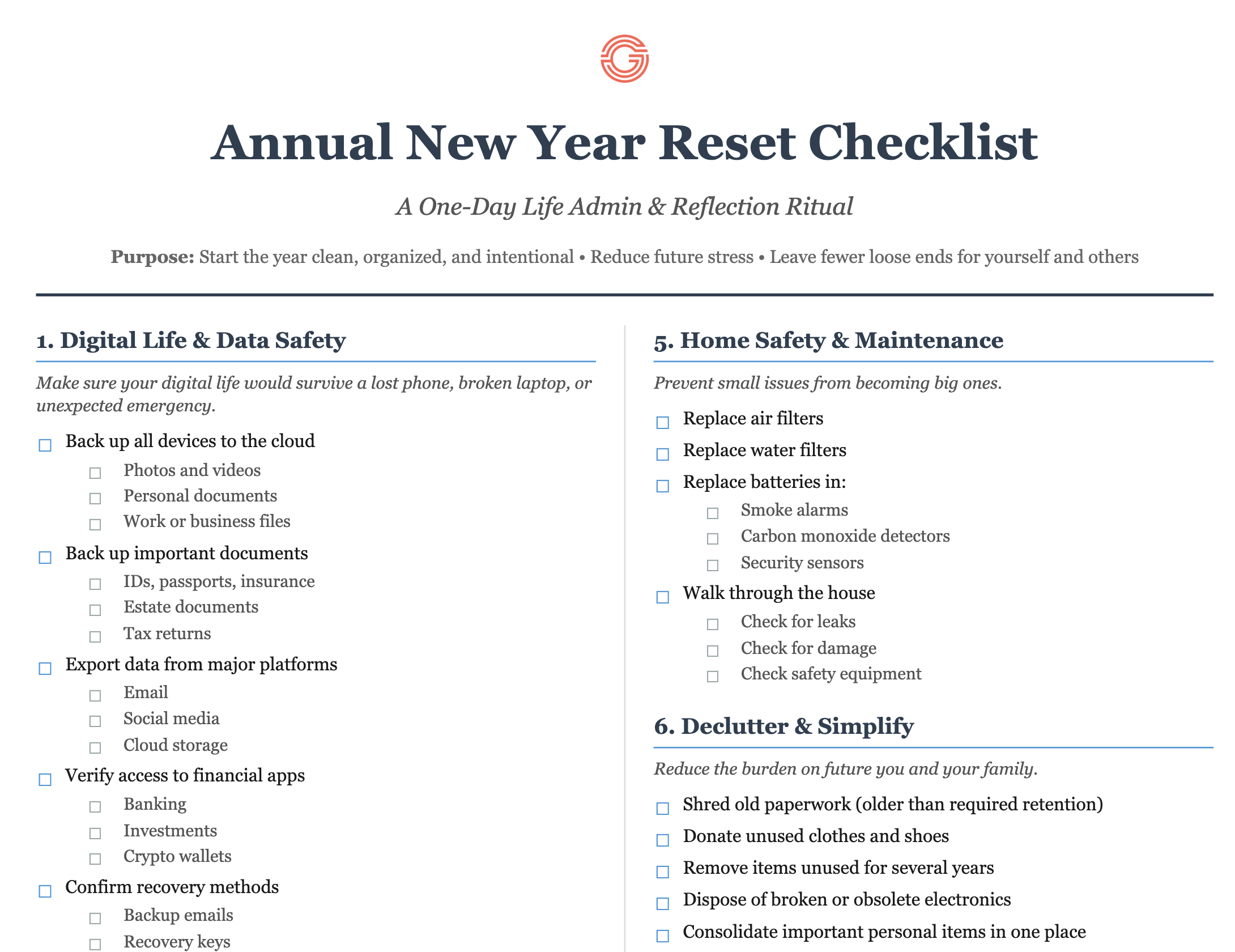
This is not a productivity system. It is not self improvement theater. It is a practical, one day ritual that clears mental space and quietly protects your future self.
I do it once a year. I recommend others do the same.
What This Reset Is Really About
At its core, this checklist does three things.
First, it reduces fragility. If you lost your phone, laptop, or access to an account tomorrow, would your life grind to a halt or recover calmly?
Second, it removes invisible stress. The kind that sits in the background. Unfiled documents. Forgotten subscriptions. A will that has not been updated since a major life change.
Third, it creates continuity. For your family. For your work. For the version of you that will exist ten years from now.
None of this is exciting. All of it matters.
The Immediate Benefits
The most obvious benefit is relief.
There is a noticeable lightness that comes from knowing your backups work, your passwords are organized, and your important documents are not scattered across devices and drawers.
For example, backing up photos sounds mundane until you realize those photos are the only record of entire phases of your life. Devices fail. Accounts get locked. Cloud services change terms. Redundancy is not paranoia. It is respect for memory.
The same applies to finances. Taking a snapshot of your net worth once a year is not about judging yourself. It is about clarity. You stop guessing. You stop avoiding. You replace anxiety with numbers.
Even something as small as canceling unused subscriptions can have an outsized effect. Not because of the money saved, but because it reinforces a habit of intentional ownership. You decide what stays in your life. Not inertia.

The Quiet Long Term Benefits
The deeper value of this ritual shows up later.
Years later.
When a family member needs access to something and knows exactly where to look. When a tax question comes up and you already have the folder. When a medical emergency happens and contacts and documents are current.
Most people underestimate how much cognitive load comes from disorganization. We carry it silently. It shows up as distraction, irritability, and decision fatigue.
This reset reduces that load.
It also reduces the burden on others. One of the most sobering parts of this list is the decluttering section. Not because minimalism is virtuous, but because someday someone else may have to make sense of what we leave behind.
If someone would not know why you kept something, that is a signal worth listening to.
A Few Real Examples
A few years ago, I realized that my will referenced assets that no longer existed and missed ones that did. Nothing dramatic had happened. Just time. That realization alone justified the ritual.
Another year, I discovered multiple subscriptions I had not used in over a year. Each one was a small reminder of an old intention that no longer fit. Canceling them felt less like saving money and more like closing loops.
One of my favorite parts of the list is the home walkthrough video. It takes ten minutes. You simply walk through your home and record what is there. If you ever need it for insurance or documentation, you will be grateful you did it calmly rather than under stress.
And then there is the human part.
Calling someone you lost touch with. Taking a family photo. Reflecting on people you lost or miss.
These are not productivity tasks. They are grounding moments. They remind you that the point of all this organization is not control. It is presence.
How to Approach the Day
Treat this as maintenance, not a test.
You are not trying to do it perfectly. You are trying to do it once.
Block the day or half day. Print the checklist. Use a pen. Move steadily. Do not optimize. Do not redesign your life mid task.
At the end, write three lines. One thing you are proud of from last year. One thing you want less of. One thing you want more of.
Date it. Save it.
Next year, you will look back and see a record of continuity rather than resolution.
Why This Works When Goals Often Do Not
Goals are aspirational. This is infrastructural.
Goals ask you to change who you are. Infrastructure supports who you already are.
When your digital life is stable, your finances are organized, your home is safer, and your loose ends are tied, everything else becomes easier. Not magically. Practically.
This checklist does not promise transformation. It offers steadiness.
And in a world that constantly pulls our attention forward, a single day spent closing the past year cleanly might be one of the most generous things you can do for yourself.
If you adopt it, adapt it. Make it yours. But keep the spirit intact.
One day. Once a year. Done properly.
That is enough. Download the checklist now and start !